





 Objectives
Media 
Launching the Immigrant Integration Barometer, 2014 edition - Press release
Education, data collection and centralising by public institutions - key issues of immigrant integration
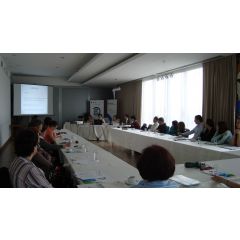
Education, data collection and centralising by public institutions - key issues for third country nationals’ integration in Romania in 2014, according to the 2014 edition of the Immigrant Integration Barometer launched by the Romanian Association for Health Promotion in partnership with the Open Society Foundation on 18 June.
In 2014 the Ministry of National Education holds no data on the number of foreign pupils enrolled in the Romanian education system, as indicated by IIB 2014. Information is centralised at county level and the county inspectorates fail to respond to information requests.
Institutions fail to adequately manage aliens’ access to the public education system: foreign minors holding no study documents may enrol in school but they may not take examinations such as the high-school graduation exam in the absence of a complete tuition record. As regards the tuition of adults holding no study documents, the only solution for them is to enrol in the "Second chance" programme. The Ministry of National Education has no evaluation methodology for the competencies of this category of third country nationals.
If immigrants hold study documents, the recognition of these documents for employment purposes is restrictive. The evaluation centres accredited by the National Authority for Qualifications evaluates competencies for only 103 professions.
IIB 2014 points out the difficulties in finding information about the necessary documents for recognition and/or equivalence. The institution in charge, the National Centre for Equivalence and Recognition of Diplomas, provides this information in Romanian language, for immigrants from outside the EU.
Other conclusions of the Immigrant Integration Barometer, 2014 edition, are listed below:
• In 2014, 38% of Romanians have a good and very good opinion about immigrants, while the opinion on foreigners of 54% of respondents is neither good, nor bad;
• The organisation of Romanian language courses for immigrants continues to be fixed and rigid; foreigners are poorly informed about the courses and the trainers are not foreign language teachers, but Romanian language teachers;
• Local public authorities have no strategies in place for immigrants’ integration, not even in the cities with a large number of immigrants;
• Local public authorities have no evidence of the number of immigrants in their administrative-territorial units;
• National public authorities are interested in security rather than in immigrants’ integration;
• The associative environment is poorly developed, the few immigrant organisations have no experience in implementing and managing project budgets;
• The immigrant from third countries has no political rights in Romania - s/he has no right to establish political parties, to participate in their meetings, to be a member, to vote and to be voted, may not participate directly in the decision making process and may submit petitions only through third parties - legally established organisations.
The Immigrant Integration Barometer 2014 was prepared within the project "Research and Information Centre on Immigrant Integration".
The project "Research and Information Centre on Immigrant Integration" is scheduled to develop over a 3 year time frame. At the end of the three years the result of the research activity will be a sound field-tested instrument to evaluate society’s openness towards immigrants.
The project "Research and Information Centre on Immigrant Integration" is financed from the European Fund for Integration of Third Country Nationals through the general programme "Solidarity and management of migration flows" (ref: IF/11.01-03.01/2012) of the European Union, managed in Romania by the Ministry of the Interior – General Inspectorate for Immigration as Contracting Authority.
More information on the Immigrant Integration Barometer 2014 and on the Research and Information Centre on Immigrant Integration can be found on www.cdcdi.ro, www.arps.ro, www.fundatia.ro.
Further details can be supplied by Victoria Cojocariu, Activity Coordinator, Open Society Foundation, and by Sandra Păduraru, Project Assistant, Romanian Association for Health Promotion, at sandra.paduraru@arps.ro.
In 2014 the Ministry of National Education holds no data on the number of foreign pupils enrolled in the Romanian education system, as indicated by IIB 2014. Information is centralised at county level and the county inspectorates fail to respond to information requests.
Institutions fail to adequately manage aliens’ access to the public education system: foreign minors holding no study documents may enrol in school but they may not take examinations such as the high-school graduation exam in the absence of a complete tuition record. As regards the tuition of adults holding no study documents, the only solution for them is to enrol in the "Second chance" programme. The Ministry of National Education has no evaluation methodology for the competencies of this category of third country nationals.
If immigrants hold study documents, the recognition of these documents for employment purposes is restrictive. The evaluation centres accredited by the National Authority for Qualifications evaluates competencies for only 103 professions.
IIB 2014 points out the difficulties in finding information about the necessary documents for recognition and/or equivalence. The institution in charge, the National Centre for Equivalence and Recognition of Diplomas, provides this information in Romanian language, for immigrants from outside the EU.
Other conclusions of the Immigrant Integration Barometer, 2014 edition, are listed below:
• In 2014, 38% of Romanians have a good and very good opinion about immigrants, while the opinion on foreigners of 54% of respondents is neither good, nor bad;
• The organisation of Romanian language courses for immigrants continues to be fixed and rigid; foreigners are poorly informed about the courses and the trainers are not foreign language teachers, but Romanian language teachers;
• Local public authorities have no strategies in place for immigrants’ integration, not even in the cities with a large number of immigrants;
• Local public authorities have no evidence of the number of immigrants in their administrative-territorial units;
• National public authorities are interested in security rather than in immigrants’ integration;
• The associative environment is poorly developed, the few immigrant organisations have no experience in implementing and managing project budgets;
• The immigrant from third countries has no political rights in Romania - s/he has no right to establish political parties, to participate in their meetings, to be a member, to vote and to be voted, may not participate directly in the decision making process and may submit petitions only through third parties - legally established organisations.
The Immigrant Integration Barometer 2014 was prepared within the project "Research and Information Centre on Immigrant Integration".
The project "Research and Information Centre on Immigrant Integration" is scheduled to develop over a 3 year time frame. At the end of the three years the result of the research activity will be a sound field-tested instrument to evaluate society’s openness towards immigrants.
The project "Research and Information Centre on Immigrant Integration" is financed from the European Fund for Integration of Third Country Nationals through the general programme "Solidarity and management of migration flows" (ref: IF/11.01-03.01/2012) of the European Union, managed in Romania by the Ministry of the Interior – General Inspectorate for Immigration as Contracting Authority.
More information on the Immigrant Integration Barometer 2014 and on the Research and Information Centre on Immigrant Integration can be found on www.cdcdi.ro, www.arps.ro, www.fundatia.ro.
Further details can be supplied by Victoria Cojocariu, Activity Coordinator, Open Society Foundation, and by Sandra Păduraru, Project Assistant, Romanian Association for Health Promotion, at sandra.paduraru@arps.ro.
 Back
Back